You‘re considering building a home — but you’re not sure whether to go with a traditional wood-framed house or a modern container home. This is one of the most common questions homeowners face today.
The short answer is: a container home is typically 50-60% cheaper and 10 times faster to build than a traditional stick-built house.
But the full picture involves more than just upfront cost. This guide breaks down everything you need to know — cost, time, permits, maintenance, resale value, and long-term ROI — using 2026 data.
1. Upfront Cost Comparison
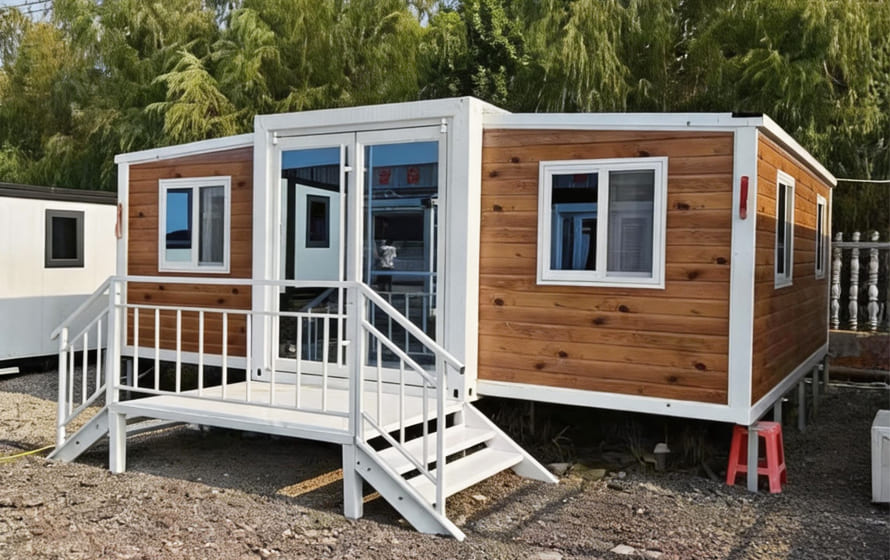
Let‘s start with the numbers that matter most. The table below compares a 20ft and 40ft expandable container house with a traditional wood-framed house of comparable size.
| Cost Category | 20ft Expandable Container | 40ft Expandable Container | Traditional Wood House (40ft equivalent) |
|---|---|---|---|
| Base cost (FOB) | 6,500 | 10,000 | — |
| Ocean freight + customs | 5,000 | 6,500 | — |
| Site prep (gravel pad) | 800 | 800 | 8,000 |
| Utility hookup | 2,500 | 3,000 | 15,000 |
| Permit fees | 1,000 | 1,500 | 10,000 |
| Foundation | Not required (gravel is fine) | Not required | 20,000 |
| Interior finishing | 5,000 | 8,000 | 50,000 |
| Total Landed Cost | 35,000 | 48,000 | 150,000 |
*All figures are 2026 market estimates for the US market. Landed cost includes everything from factory to move-in.*
Key takeaway: A 40ft expandable container house costs roughly one-third to one-half of a traditional wood house of similar size.
2. Why Is a Container Home So Much Cheaper?
The price difference isn‘t magic — it’s the result of fundamental differences in how each home is built.
| Cost Factor | Traditional House | Expandable Container House |
|---|---|---|
| Labor | High — multiple trades (carpenters, electricians, plumbers) working for months | Low — 2-3 people, 1-2 days on-site |
| Materials | Lumber, drywall, roofing, insulation — prices volatile, especially post-COVID | Prefab steel + sandwich panels — stable pricing |
| Construction waste | 10-20% of materials end up in dumpsters | Minimal — factory precision cuts |
| On-site time | 4-8 months (weather delays common) | 2-3 days (no weather dependency) |
| Financing | Construction loan (8-12% interest, draw schedule) | Cash or small personal loan |
| Contingency budget | 15-20% for unexpected issues | 5-10% — fewer surprises |
The biggest driver of savings: labor. A traditional home requires dozens of workers over many months. A container house requires 2-3 people over 2 days.
3. Build Time Comparison
Time is money — especially if you‘re paying rent or a mortgage during construction.
| Milestone | Traditional House | Expandable Container House |
|---|---|---|
| Design & planning | 2-4 months | 1-2 weeks |
| Permit approval | 1-6 months (varies by city) | 2-4 weeks (simple ADU registration) |
| Foundation | 2-4 weeks | Not needed |
| Framing | 2-4 weeks | Pre-built at factory |
| Rough-ins (electrical, plumbing) | 2-3 weeks | Pre-installed at factory |
| Insulation & drywall | 2-3 weeks | Pre-installed at factory |
| Finishing | 4-8 weeks | 1-2 days (unfold + connect) |
| Total time to move-in | 6-12 months | 2-4 weeks (plus 6-8 weeks shipping) |
*Shipping from China to the US takes 6-8 weeks. Once the container arrives, you can move in within 2-3 days.*
Key takeaway: A container home can be ready 10x faster than a traditional build.

4. Permit & Regulatory Comparison
Many homeowners assume a container home is harder to permit. In most cases, the opposite is true.
| Aspect | Traditional House | Expandable Container House (as ADU) |
|---|---|---|
| Zoning requirements | Strict — must meet all local codes | Flexible — treated as temporary structure in many areas |
| Building permit | Required — full plan review | Simple registration in many cities |
| Setback requirements | Standard | Often reduced for ADUs |
| Owner occupancy | Not required | Not required in ADU-friendly states (CA, OR, WA) |
| Architect stamps | Required | Not required for prefab certified units |
| Inspections | Multiple (foundation, framing, electrical, etc.) | One final inspection (sometimes none) |
Best states for container ADUs: California, Oregon, Washington, Colorado, Texas (Austin specifically).
Key takeaway: If you live in an ADU-friendly state, permitting a container home is significantly easier and faster than a traditional house.
5. Maintenance & Longevity
| Consideration | Traditional House | Expandable Container House |
|---|---|---|
| Lifespan | 50-100 years | 25-50 years |
| Annual maintenance | 1-2% of home value (~1,000−3,000/year) | Low — inspect seals and paint every 2-3 years |
| Pest risk | Termites, carpenter ants, rodents | Minimal — steel frame |
| Fire risk | Moderate | Low — steel non-combustible |
| Weather resistance | Varies by build quality | Good — wind-resistant (level 10), seismic (mag 8) |
| Rust risk | N/A | Low — galvanized + spray coating (10-15 years) |
Key takeaway: A container home requires less day-to-day maintenance but has a shorter lifespan. For many buyers, the lower upfront cost and minimal maintenance outweigh the shorter lifespan.
6. Resale Value & ROI
| Factor | Traditional House | Expandable Container House |
|---|---|---|
| Appreciation | Tracks land value + inflation | Depreciates as structure, but land may appreciate |
| Buyer pool | Large | Growing, especially among younger buyers |
| Rental income potential | Moderate | High (unique Airbnb appeal) |
| Relocatable | No | Yes — can be sold separately from land |
| Typical resale value (5 years) | 80-100% of purchase price | 50-70% of purchase price (structure only) |
Key takeaway: A traditional house is a better long-term investment if you plan to hold for 20+ years. A container house is better if you want lower upfront cost, faster move-in, or rental income potential.
7. Which One Should You Choose?
| Your Priority | Recommended Choice |
|---|---|
| Lowest upfront cost | ✅ Expandable container house |
| Fastest move-in time | ✅ Expandable container house |
| Traditional neighborhood aesthetic | Traditional house |
| Relocatable living | ✅ Expandable container house |
| Long-term land investment | Traditional house |
| Rental/Airbnb income | ✅ Expandable container house |
| Financing available | Traditional house (easier to mortgage) |
| Low maintenance | ✅ Expandable container house |
8. Real-World Example
Case: A 40ft expandable container house in Austin, TX

| Item | Amount |
|---|---|
| Landed cost | $38,000 |
| Used as | Primary residence for a couple |
| Monthly expenses (utilities, insurance) | $250 |
| Comparable traditional home cost (40ft equivalent) | $120,000+ |
| Savings | $80,000+ |
The owners moved in 3 months after ordering. A traditional home on the same lot would have taken 10 months and cost triple.
9. Bottom Line
A 40ft expandable container house costs about 50-60% less than a traditional wood house of comparable size and can be ready in days, not months.
Choose a traditional house if you value permanence, traditional financing, and long-term land appreciation.
Choose an expandable container house if you want lower upfront cost, faster move-in, or the flexibility to relocate.
👉 Ready to compare costs for your specific project? Contact us with your location and size preference. We’ll provide a detailed quote within 24 hours.
Disclaimer: The above prices are 2026 market estimates. Actual costs may vary based on customization, raw material prices, exchange rates, and destination port fees.